Entity fragmentation is how AI search systems splinter your expertise across multiple weak or misaligned identity signals, so that your authority gets misattributed and your content gets suppressed. This page introduces a technical framework for solving entity defragmentation in the context of professional work history, and its impact on authority and visibility in search results.
The resulting impact is bigger than simple misattribution. A fragmented identity impacts trust, visibility, and revenue. Most people do not even realize this problem exists. This problem applies to any entity, including brands. This particular application focuses on how fragmentation affects the individual professional or consultant, based on my personal experience. In simple terms, my case of mistaken identity in AI search results.
AI search does not “understand” your career the way a human does. It reconstructs your identity based on patterns it can validate. When those patterns break, your expertise gets fragmented, misattributed, or lost entirely. This is a technical breakdown of why that happens.
For decades, the internet ran on keywords. A keyword is just a string of text. Flat, isolated, with no inherent meaning to the machines reading it. What has replaced it is an entity-based system, where everything with a name, a person, a role, a company, a credential, exists as a node in something called a Knowledge Graph.

Think of the Knowledge Graph as a map. Not a list of names and addresses, but a living, three-dimensional map where every person, company, and career milestone occupies a coordinate. Every entity on that map has a vector embedding, a precise coordinate like longitude and latitude, calculated from the signals the system can verify about you: your roles, your companies, your credentials, the language associated with your expertise. Your vector embedding is where the map says you live.
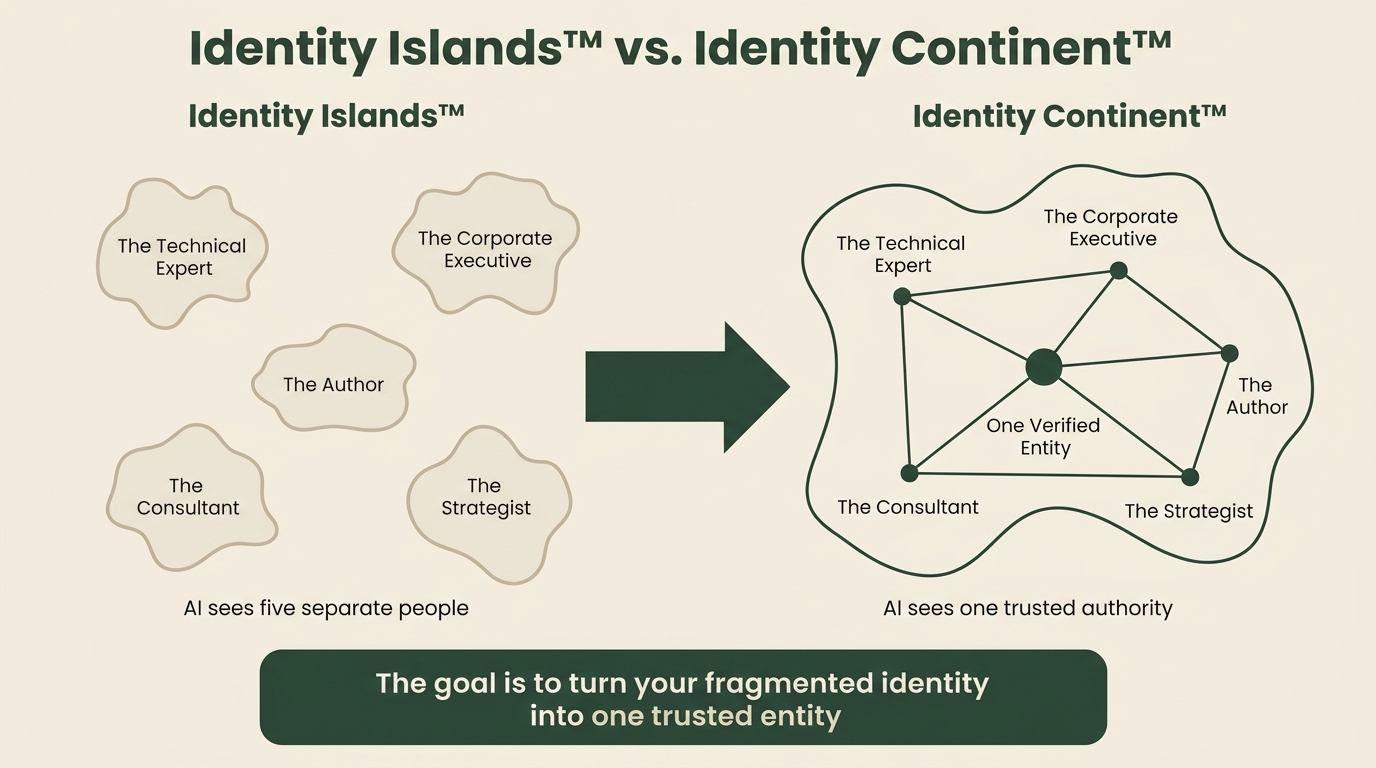
The nodes that represent you are your Identity Islands. The strength of your presence on that map depends entirely on whether those islands form a continuous landmass or sit scattered across open water.
AI systems are fundamentally risk-averse. They trust patterns they can validate, and the pattern they were trained to recognize is a predictable career arc: one industry, one trajectory, roles that follow a logical sequence.
A non-linear career does not fit that pattern.
The gap between any two of your Identity Islands is measured in semantic distance, similar to nautical miles on that map. When the semantic distance between your islands is small, the system can see clearly from one to the other. It confirms they belong to the same person and pulls them together. But when the distance is too great, that crossing disappears into fog. The system's confidence drops. It doesn't want to misjudge how far away the island is.
So it does what any risk-averse system does when faced with uncertainty: it looks for a closer match. It finds another entity whose coordinates sit nearer to your isolated island and starts calculating the probability that your island belongs to them instead. Assumptions fill the gap. Fragmentation of your identity follows as your expertise is grouped with a different entity, where the system assumes that the size and shape of that island are a better fit.
The result is not a single, coherent version of you on the map. It is several partial versions. Your experience is distributed across multiple entities, your authority is divided, and your career history is reassembled around the wrong person.
For anyone with a non-linear career, this is the source of all of it:
You appear invisible in search and answer engines, regardless of how much expertise you have or content you've created
Your experience gets mapped to multiple people with the same or similar names
Other people's experiences get tied to your name
Prospects cannot find anything online that validates your expertise, and what they cannot verify, they do not trust
This is an entity fragmentation problem.
Ever get a message that you need to defrag your hard drive? The parts of your data files are saved in random spots all over your hard drive. You have to defragment the drive to pull them back together.
The same is true with Identity Islands. Sometimes the islands have drifted so far apart that the system's confidence is so low that it simply suppresses the signal, leaving your Identity Islands adrift and at the mercy of the current. So one day your expertise looks like it belongs to you, and another day it looks like it belongs to someone else with the same name.
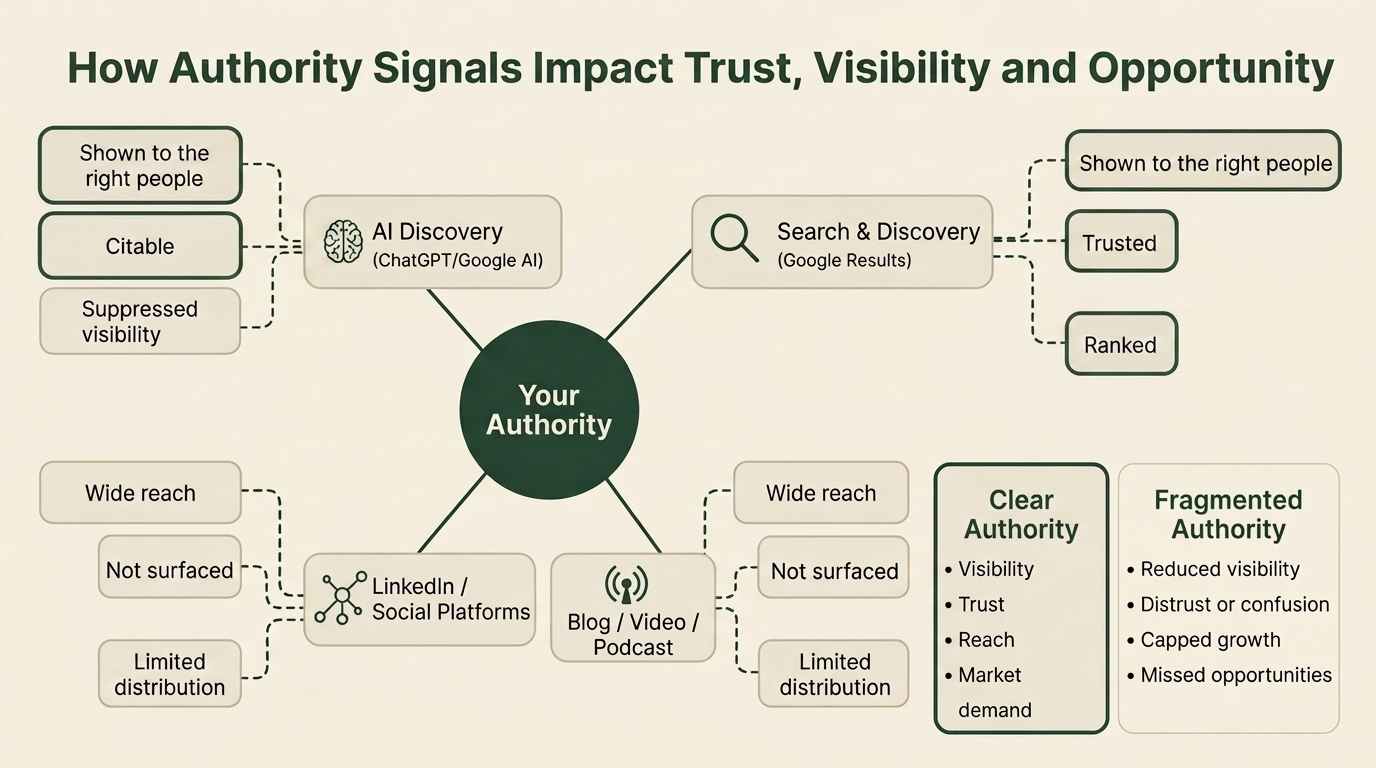
Fragmentation alone is damaging enough. But the platforms your ICP uses every day, Google, LinkedIn, and YouTube, have a scoring system built on top of the Knowledge Graph that turns a fragmentation problem into a visibility problem.
That system is E-E-A-T: Experience, Expertise, Authoritativeness, Trustworthiness. Think of it as a credit score for your professional identity. Just like a financial credit score, you cannot see the number. You only see the consequences of it. And just like a credit score, it is calculated not from what you know you have, but from what the system can verify.
When your Identity Islands are fragmented, your E-E-A-T score is low. Not because your expertise is low. Because the system cannot connect the signals. Your authority is real, but it is scattered across multiple partial identities. None of them is strong enough to clear the threshold. In credit terms, the funds are there; they just exist across accounts that the system does not recognize as yours.
The platforms respond to a low score the same way a lender responds to bad credit: they limit what you can access.
Google Search uses E-E-A-T to decide which expert to surface in an AI Overview. If your entity node does not meet the confidence threshold for your claimed area of expertise, you are not cited, regardless of how long you have been in the field or how much you have published. A competitor with weaker actual expertise but better-connected signals gets the placement instead.
LinkedIn (Brew 360) cross-references the topic of every post you publish against your verified career history. When the topic and the history do not connect within its confidence parameters, your reach is throttled. Your content stays inside a small circle instead of reaching the broader audience your expertise should earn.
YouTube uses automated transcription and entity detection to link your spoken words to your professional record. A strong, resolved entity node amplifies your content's reach. A fragmented one caps it, regardless of production quality, consistency, or how good the content actually is.
It is worth understanding why this system exists. E-E-A-T was designed to solve a real problem. The internet is flooded with low-quality, AI-generated content. Generic, surface-level, indistinguishable from expertise at a glance but empty underneath. The scoring system exists to protect users from it. It rewards demonstrated, verifiable, deep expertise, the kind that produces genuinely useful experiences for the people searching for answers.

That is actually good news for you. AI-generated content cannot replicate what you have. It can mimic vocabulary. It cannot replicate decades of pattern recognition, lived experience across industries, or a specific record of results. The E-E-A-T system is designed to know the difference and to reward the real thing with visibility.
The problem is that your map is showing your expertise as uncharted territory. E-E-A-T cannot do anything with unattributed or incorrectly attributed expertise.
Until the score is repaired, it is unlikely that your ICP will see the content you create. You will not be surfaced in traditional search. You will not appear in AI-generated answers. Every piece of content you publish gets scored against a fragmented identity and suppressed accordingly. You are not just invisible. You are actively working against yourself every time you post.
Moving from fragmented Identity Islands to an Identity Continent requires a specific technical process called Entity Resolution. It is not a content strategy. This is the entity and authority layer of GEO and AEO: the work of making your identity, expertise, and trust signals coherent enough for optimization to compound.
Without this technical work, optimization can reinforce fragmentation rather than resolve it. At its core, the work is about pulling your Identity Islands together and redrawing the map as one larger, verified landmass where the system previously saw several unrelated ones.
The way you redraw the map is by creating signals that reduce the semantic distance between your islands, moving them close enough together that the system's confidence climbs above the threshold and it begins to recognize them as belonging to the same entity. This is done through structured data, content strategically created to fill in the gaps that AI previously filled with assumptions, and cross-platform signal alignment that makes your identity readable the same way from every direction.
This process is called Structural Bridging.
The goal of Structural Bridging is not to tell the system who you are. It is to show it, in machine-readable terms, across every crawlable surface, so that the connections it was previously guessing at become verifiable facts. Every bridge you build between your islands reduces the fog. Every verified connection raises your confidence score. Over time, your islands stop drifting and begin consolidating into a single Identity Continent.

For many senior professionals, Structural Bridging alone is not enough. Some of your islands are not just far apart. They are being actively held in the wrong position.
This is anchor drag.
When you left a legacy organization, your professional connection to that entity ended. But the digital record did not. Every press release that named your role. Every industry article that featured you. Every marketing asset your former employer built around your title and your name. That content did not disappear when you resigned. It is still indexed. Still being crawled. Still being read by the Knowledge Graph as a current, authoritative signal about who you are and where you belong on the map.
And here is what makes it particularly difficult for the most accomplished professionals: those signals are not just sitting on one site you could theoretically correct. They are distributed across dozens of high-authority domains, publications, industry sites, conference archives, and the legacy org's own web presence, which you do not own and cannot control. The more visible you were inside that organization, the more distributed your anchor drag is.
The system trusts Forbes about you more than it trusts you about yourself.
A brand new signal you publish today on your own domain is competing against a Forbes feature from your SVP days that carries a trust weight your independent site may not match for years. This is a signal weighting problem, and for professionals coming out of high-authority legacy roles, Entity Resolution is not a nice-to-have. It is a must-have that needs to be part of your business plan, especially if you are pivoting with a career change. Because those legacy signals are so powerful that they can limit your ability to attract leads online and interfere with prospect research. It can be the difference between a high-trust closed deal and a prospect feeling doubt and ghosting you because your online signals were mixed.
The anchor drag does not release all at once. Legacy signals decay over time as the Knowledge Graph ingests more recent data, but decay is not deletion. You are not waiting for the old signals to disappear. You are building enough new signal weight to overtake them. The process moves through three phases:
In the first phase, you establish your authority footprint using structured data. Think of it as claiming your Identity Island, the one that previously had your name on it but was attached to your old employer's landmass. You detach it. It becomes a floating island on its own. By giving it a structured data footprint, you are dropping an anchor, establishing it as the base of a new continent, one that represents you as your new, unique business identity. That could be your name, your company name, or both.
In the second phase, you corroborate. Third-party sources begin validating your claims. This is where the system begins to take your new signals seriously.
In the third phase, you reach the tipping point. Your new authority signals consistently outweigh the legacy ones. The vector anchor drops, locking that island to your landmass. Your Identity Continent is now the dominant signal the system reads when it encounters your name.

There is no shortcut between these phases. The timeline depends on the authority weight of the legacy signals you are working against, the volume and consistency of the new signals you are building, and whether third-party corroboration arrives early or late. What is certain is that every day you do not start is another day the anchor weighs you down.
The Knowledge Graph is not static. It is ingesting new data constantly, and that constant ingestion creates movement. Islands drift. They get pulled toward other entities, repositioned by every new signal the system absorbs. Until your identity is fully resolved and locked, your risk of continued fragmentation is higher as more data gets ingested into the Knowledge Graph.
This is why consistency across every signal is not optional. It is the mechanism that prevents your islands from drifting back apart after you have worked to bring them together. Different titles on different platforms. Different positioning statements. A bio that describes you one way on LinkedIn and another way on your website. Each inconsistency is a current pulling an island in the wrong direction. Each one lowers the confidence score the system has assigned to your resolved identity.
The system is not reading your intent. It is reading your signals. If those signals contradict each other, the system treats the contradiction as evidence of fragmentation and responds accordingly.
Reducing semantic distance brings your islands together. Consistent signals keep them from drifting. But to give the system something it can use to identify you specifically and unambiguously, you need vector anchoring.
Vector anchoring is the use of unique identifiers specific enough to you that the system cannot confuse you with anyone else. They function as coordinates that stay constant across all of your Identity Islands, giving the Knowledge Graph a reliable fixed point to anchor your entire landmass.
Consider the name problem. There are over 500 LinkedIn profiles for people named Tia Williams. Without a disambiguating anchor, the system has no reliable way to determine which signals belong to which person. It makes probability-based assumptions, and as we have established, those assumptions can leave you fragmented.
A middle initial helps. Tia A. Williams is a narrower coordinate than Tia Williams. But a name alone, even a distinctive one, is not sufficient. A high-authority source can take that same anchor and use it to confirm the wrong identity. A Forbes article that says "Tia A. Williams, SVP, Corporate Finance Institute" is a signal that directionally determines where the island will drift to next.
What the system cannot replicate or reassign is a signature system, a proprietary methodology, a named framework, a term you coined that exists nowhere else in the landscape. When you own a term that only exists in connection with your name, you create a vector anchor that the system cannot confuse with anyone else. It is not just a branding decision. It is a technical one. A signature system makes you a citable authority rather than a practitioner, because there is no other source the system can cite for that concept except you.
The emphasis on uniqueness is not aesthetic. If the methodology you name is generic enough that others use similar language, the system collapses you into a broad category, and your authority score reflects the category, not you specifically. Uniqueness is what keeps the anchor from dragging.
By dropping a vector anchor across all of your Identity Islands, your name in its consistent form, your signature systems, and your proprietary terms, you lock your islands together into your Identity Continent. They stop drifting. They stop getting pulled toward other entities by the constant current of new data ingestion. They hold.
Entity Resolution is not about gaming the system. It is about giving a fundamentally risk-averse system enough verified, consistent, cross-referenced information to do what it was always designed to do, surface the most credible expert for a given query.
Once your Identity Continent is resolved, your full career history becomes portable authority. Every piece of content you publish gets scored against a strong, coherent entity with a high confidence score. Every platform that previously suppressed your content begins distributing it. Every search, traditional or AI-generated, that is relevant to your expertise has a clear, verified answer to return.
The work is not about building something new. It is about making your existing expertise and authority visible and accessible to the people already looking for you, and making sure the map never gets it wrong again.
Once your Identity Continent is established and your signals are working for you rather than against you:
Content that was previously suppressed becomes more visible as your E-E-A-T score rises to reflect your actual expertise
Your identity and depth of experience become apparent to both humans and machines. You finally get credit for the authority you have already built
You get found in AI Overviews and may be surfaced as a cited authority in your niche, rather than being passed over for someone with weaker expertise and stronger signals
Your visibility in traditional search increases. AI search and traditional search now use the same underlying Knowledge Graph to determine where you appear in results, so fixing one fixes both
Your social content reaches further as platforms like LinkedIn and YouTube recalibrate your reach to match your restored confidence score
Higher trust translates to more opportunities. Prospects who find you see a coherent, verified expert rather than a fragmented or misattributed identity, and that difference shows up in how deals close.
The map is correctable. The signals are rebuildable. And once the system can see what you have always had, it works in your favor the same way it was working against you.
AI determined that my non-linear career was so statistically improbable that I had a better chance of winning the Powerball lottery twice than for it to consider my work history as accurate. So it fragmented me, and 28 years of experience disappeared.
But I fixed it. See what happened and the before and after for how I did it.
A Knowledge Graph is the system search engines use to map relationships between entities -- people, companies, roles, and credentials. Your position on that map determines whether AI search can find, trust, and surface you as an authority. A fragmented or inconsistent career signal puts you in the wrong position.
Semantic distance is the gap between your Identity Islands as measured by AI systems. When that gap is too large for AI to bridge confidently, it stops connecting your roles and looks for a closer match and begins attributing your experience to them instead.
Anchor drag occurs when legacy signals from a former employer continue to hold your professional identity in the wrong position on the Knowledge Graph. Press releases, industry articles, and marketing assets from your previous role are still indexed and read as current signals. The more visible you were inside a high-authority organization, the more distributed your anchor drag is.
Structural Bridging is the technical process of reducing semantic distance between Identity Islands by creating machine-readable connections between legacy roles and current work. The goal is to show the system across every system that connections AI was previously guessing at are verifiable facts.
Vector anchoring is the use of unique identifiers specific enough to you that AI cannot confuse you with anyone else. A proprietary methodology or named framework you coined is a vector anchor AI cannot reassign to another entity, making you a citable authority because no other source can be cited for that concept except you.
Entity Resolution is the technical foundation that content marketing depends on. Without it, publishing more content can reinforce fragmentation rather than resolve it. You are re-architecting the logic of your authority so both machines and humans can interpret it accurately before optimization can compound.
AI search and traditional search use the same underlying Knowledge Graph and some of the same principles. When your entity is resolved and your confidence score rises, both systems recalibrate simultaneously, improving your visibility in Google search, AI Overviews, LinkedIn reach, and YouTube distribution at the same time.
E-E-A-T stands for Experience, Expertise, Authoritativeness, and Trustworthiness -- a scoring system calculated from what AI can verify, not what you know you have. When your Identity Islands are fragmented, your E-E-A-T score is low not because your expertise is low but because the system cannot connect the signals to a single verified entity.
The timeline depends on the authority weight of legacy signals you are working against and the volume and consistency of new signals you are building. The process moves through three phases: establishing your authority footprint with structured data, corroborating with third-party sources, and reaching the tipping point where new signals consistently outweigh legacy ones.
Professionals with non-linear careers, significant title jumps, transitions from corporate to independent work, common names, or experience built under high-authority employers are most at risk. The Authority Penalty for Success means the more accomplished your corporate career was, the harder it becomes to establish independent authority in AI search.
© 2026 Tia A. Williams All Rights Reserved.
Free Resources: Women in Tech Paradox | Born A Stastic Built To Be A Leader - 2 Free Chapters