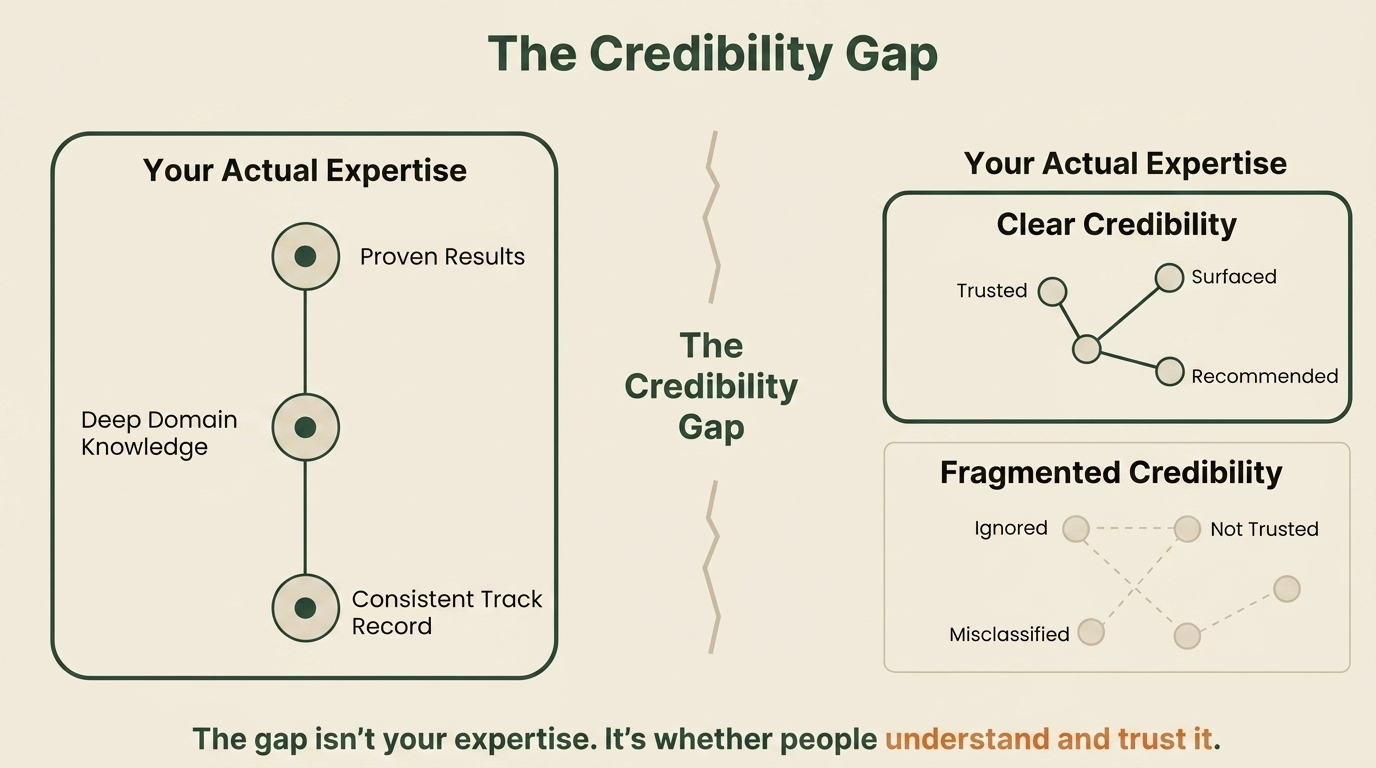
AI systems are not designed to interpret outliers. They are built on probability and pattern recognition. When a career is non-linear, when someone changes industries, or when they make a significant title jump, AI does not know how to reliably interpret that data. It does not match an expected progression, so the system fills in the gaps with assumptions.
For individual experts, the consequences are real: suppressed visibility, missed opportunities, and income that never materializes because the right people can’t find you or find the wrong version of you.
This case study breaks down why that happens, what the fix looks like, and why the solution has nothing to do with producing more content.
In my case, there was not enough connective tissue across my roles. As a result, AI treated parts of my career as belonging to different people with the same name. When my actual path did not fit the pattern it expected, it attributed some of that experience to others whose roles seemed to make more sense.

To correct this, I applied a systems-based reconstruction approach. That meant strengthening machine-readable data consistency, creating bridges between legacy and current roles, and formatting my content for use in answer engines.
As those connections became clearer, AI systems were able to interpret my identity more accurately, connect my expertise across domains, and begin surfacing my content as a trusted source.
In my case, that risk was compounded by multiple factors. I built a non-linear career without a degree, spanning datacenter, cloud architecture, technical education, executive leadership, and entrepreneurship. Rapid promotion during M&A made that progression appear not just unusual, but statistically improbable. Over three years, I advanced from Training Architect to Director to Vice President, with each promotion aligned with the acquisitions of Linux Academy by A Cloud Guru and then of A Cloud Guru by Pluralsight.
From an AI perspective, it was the perfect storm for entity conflict.
Why My Authority Was Suppressed:
I was dealing with two compounding system failures.
First, there was an entity resolution failure. My career was fragmented across multiple identities, making it difficult for AI systems to interpret my experience as a single, continuous body of work.
Second, there was an authority weighting imbalance. Legacy signals from high-authority employers carried more weight than my current work. Because those signals were older, more established, and widely referenced, they continued to override newer, more accurate representations of my expertise.
Together, this created a structural disadvantage. The more successful my career had been inside high-authority organizations, the harder it became for AI systems to recognize and trust my authority once I became independent.
This is what I call the Authority Penalty for Success.
These failures showed up in two ways:
Legacy authority dominance: Massive domains like Pluralsight and CFI carried so much authority that, because they did not point to my current work, AI kept anchoring my identity to the past. Those signals were so strong that they effectively muted my individual authority.
Role fragmentation through pattern mismatch: Because AI systems could not find a logical bridge between Training Architect, Director, Vice President, Consultant, and Book Author, they interpreted those roles as belonging to different people. To reduce the risk of factual error, they siloed my roles and often merged me with other high-profile “Tia Williams” entities in product design and tech.
One important nuance is that this does not correct all at once. Authority signals do decay over time, but highly trusted domains decay slowly. Correcting outdated authority requires significantly stronger and more consistent signals than building authority from scratch. During that period, results can fluctuate as older and newer signals compete for priority.

If you want a deeper understanding of why AI systems struggle to trust and validate expertise, especially for non-linear careers, I break this down in detail here: Why AI Doesn’t Trust You.
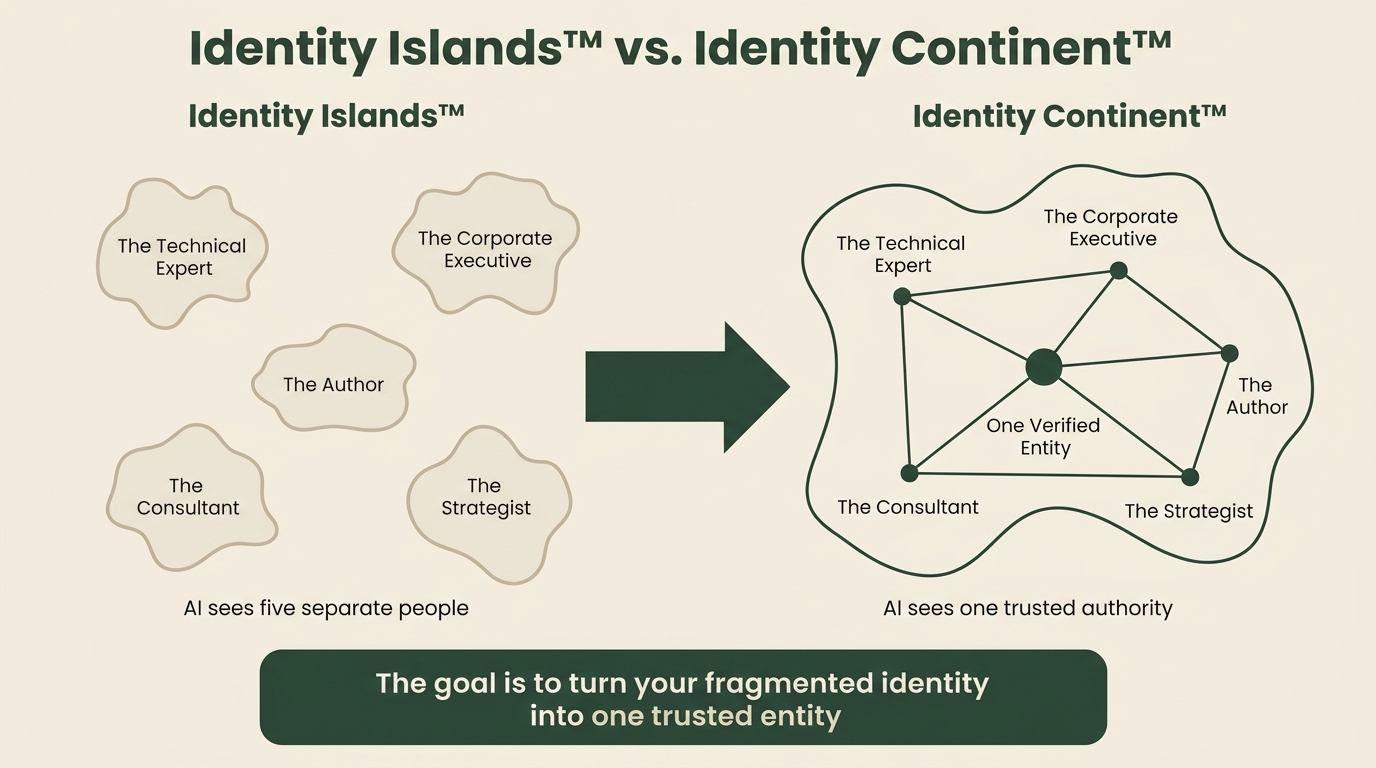
Before I intervened, my expertise had lost any cohesive narrative. I call this Identity Islands. At the system level, it is a form of entity fragmentation.
In my case, there were multiple, disconnected Identity Islands that AI could not reliably connect into one professional identity. To an AI system, these islands did not look like one person with a complex career. They looked like separate people or unrelated data points.

A useful way to think about this is as a puzzle. Each piece of data AI found had to fit a pattern it could recognize and validate. The pieces that fit expected patterns were absorbed into a plausible story. The pieces that did not fit remained unresolved, disconnected, or were attached to the wrong identity.
In practice, my career had been split into five separate Identity Islands:
Island 1: The Training Architect
Linux Academy — technical roots
Island 2: The M&A VP
A Cloud Guru / Pluralsight — rapid scale during acquisition
Island 3: The SVP
CFI — executive authority inside a corporate brand
Island 4: The Author and Independent Consultant
The Leadership Equation
Island 5: The Inbound Authority Strategist
AEO / GEO specialist
When prospects or recruiters searched for me, they did not see a clear, trustworthy authority. They were seeing inconsistent information drawn from different parts of my career. When machine-readable data does not align with the human-readable reality of someone’s expertise, trust breaks down because the system cannot verify the full story.
At its core, the root cause of this issue was a failure in entity resolution. AI couldn’t reliably connect my experience, identity, and current authority into one credible professional profile.
The challenge was how to reconnect the Identity Islands so AI could resolve them into a single credible, trusted identity.

This was not a matter of adding more content or refining keywords. It was a systems problem, and I solved it by re-architecting the logic of my authority so both machines and humans could interpret it more accurately. That required a dual-layered approach: creating machine-readable connective tissue between roles treated as separate identities, while aligning that structure with human-readable expertise and proof.
Align machine-readable trust signals with human-readable expertise.
Logic over volume. Instead of producing more content, I created better-structured content. I productized my expertise by naming and organizing my proprietary approaches around a consistent signature vocabulary, including frameworks such as The Leadership Equation™ and the Inbound Authority System™. That gave AI a clearer and more distinctive data pattern to recognize across the web.
Structural bridging. I used GEO to establish foundational data points and connect my legacy roles to my current work. That meant creating clearer bridges between past executive authority and present-day expertise so AI could interpret them as belonging to the same professional identity. For example, I added Ex-VP, A Cloud Guru to my YouTube and LinkedIn profiles to make the connection between past roles and current authority easier to resolve.
Answer Engine Optimization. In AI search, the click is often optional, but citations are increasingly what demonstrate authority. If you are not the cited source, your expertise is less likely to shape the answer. I restructured expertise-driven content into modular, question-based formats to make it easier for AI systems to retrieve direct answers from my work, attribute those answers to me, and treat my expertise as something they could cite with greater confidence rather than reconstruct from fragmented signals.
The result was the recovery of two years of suppressed work. As AI resolved the conflicts across my identity footprint, my expertise began surfacing again in places it had previously been ignored.
Previously Suppressed Content Began Surfacing: YouTube videos, LinkedIn posts, and articles from the last two years previously ignored because AI couldn't verify the source, suddenly began surfacing in AI-generated answers.
AI Began Citing My Work Directly: AI models now link specific user queries to exact timestamps in some of my videos. By reconstructing my authority, I’m not just visible, I’m cited as the primary source for specific topics in my niche.
My Authority Started Detaching From Former Employers: By strengthening my individual authority signals, I made it easier for AI to interpret my consultancy as the current evolution of my 28-year career, reducing the legacy authority signals associated with my past employers.
In this AI-first world, where authority and trustworthiness have become currency, your reputation is no longer defined only by what you say about yourself. It is increasingly shaped by what machines can understand, connect, and validate.
Authority is no longer inferred from visibility or content volume alone. It is established through entity coherence, consistent machine-readable signals, and structured alignment between identity, expertise, and content.
For senior experts, linear progression is often the exception rather than the rule. That makes the risk of fragmentation high. When authority fragments, the consequences are not just reputational. They affect discoverability, trust, reach, and income.
Three forces are shaping this shift:
This was not a matter of adding more content or refining keywords. It was a systems problem. The fix required re-architecting the logic of my authority so both machines and humans could interpret it accurately, creating machine-readable connective tissue between roles that had been treated as separate identities, while aligning that structure with human-readable expertise and proof.
The first priority was logic over volume. Instead of producing more content, I created better-structured content. I named and organized my proprietary approaches around a consistent signature vocabulary, including frameworks like The Leadership Equation™ and the Inbound Authority System™. That gave AI a clearer and more distinctive data pattern to recognize across the web.
The second was structural bridging. I used GEO to connect my legacy roles to my current work, creating explicit bridges between past executive authority and present-day expertise so AI could interpret them as belonging to the same professional identity. Adding "Ex-VP, A Cloud Guru" to my YouTube and LinkedIn profiles was one small example of that — a deliberate signal that forced the AI to treat my past and present as a continuous story rather than separate ones.
The third was Answer Engine Optimization. In AI search, the click is often optional but citation is not. If you are not the cited source, your expertise is less likely to shape the answer. I restructured expertise-driven content into modular, question-based formats to make it easier for AI systems to retrieve direct answers from my work and attribute those answers to me with confidence.
That gap can be closed by putting individual experts back in control of their authority footprint, rather than leaving it to fragmented third-party signals, stale data, and legacy trust tied to entities that no longer accurately represent their expertise.
Without that structure, non-linear careers are more vulnerable to misclassification, suppression, and fragmentation across search and answer engines. In this environment, authority has to be engineered by establishing a clear footprint, using content to reinforce and compound trust over time, and deploying structured data as a defensive mechanism to protect the integrity of that authority.
If your authority is being fragmented, misread, or suppressed online, I help high-level consultants and technical leaders reconstruct their authority footprint for the AI-first world through the Inbound Authority System.
Tia A. Williams is an authority strategist and systems thinker specializing in AI search, entity reconstruction, and inbound authority. With over 28 years of experience spanning datacenter operations, cloud architecture, technical education, executive leadership, and entrepreneurship, she has built a non-linear career that challenges traditional models of expertise and progression.
After experiencing firsthand how AI systems fragmented and misinterpreted her professional identity, Tia developed a systems-based approach to reconstruct authority for the AI-first world. Her work focuses on helping senior experts, consultants, and technical leaders align their digital footprint so their expertise can be accurately understood, trusted, and surfaced by AI and answer engines.
She is the creator of the Inbound Authority System™ and works with consultants, founders, and professionals to take control of their authority footprint, become accurately represented in AI search, and build the kind of trusted presence that attracts and lands the right opportunities without cold outreach.
Website: https://Go.SoloBusinessAdvisor.com
LinkedIn: https://linkedin.com/in/tiaawilliams2
YouTube: https:/.youtube.com/@solobusinessadvisor
© 2026 Tia A. Williams All Rights Reserved.
Free Resources: Women in Tech Paradox | Born A Stastic Built To Be A Leader - 2 Free Chapters