For Founders, Executives, and Experts behind expertise-led businesses
Authority no longer moves through proximity, referrals, credentials, or reputation alone.
It is now interpreted through online authority systems that influence who gets recognized, trusted, recommended, surfaced, cited, and chosen.
Even when you don’t sell online, people verify you before first contact. What they find can determine whether they reach out or you lose opportunities you never knew you were being considered for.
If your expertise is not clearly understood across those systems, your authority remains trapped within your existing network, visible only to those who already know and trust you.
Referrals used to bridge that gap.
But now, even a warm referral comes with an online search. If your authority is unclear, trust can disappear, the referral weakens, and they never reach out.
That’s why you’re still chasing, proving, and re-proving expertise you already earned.
It’s exhausting.
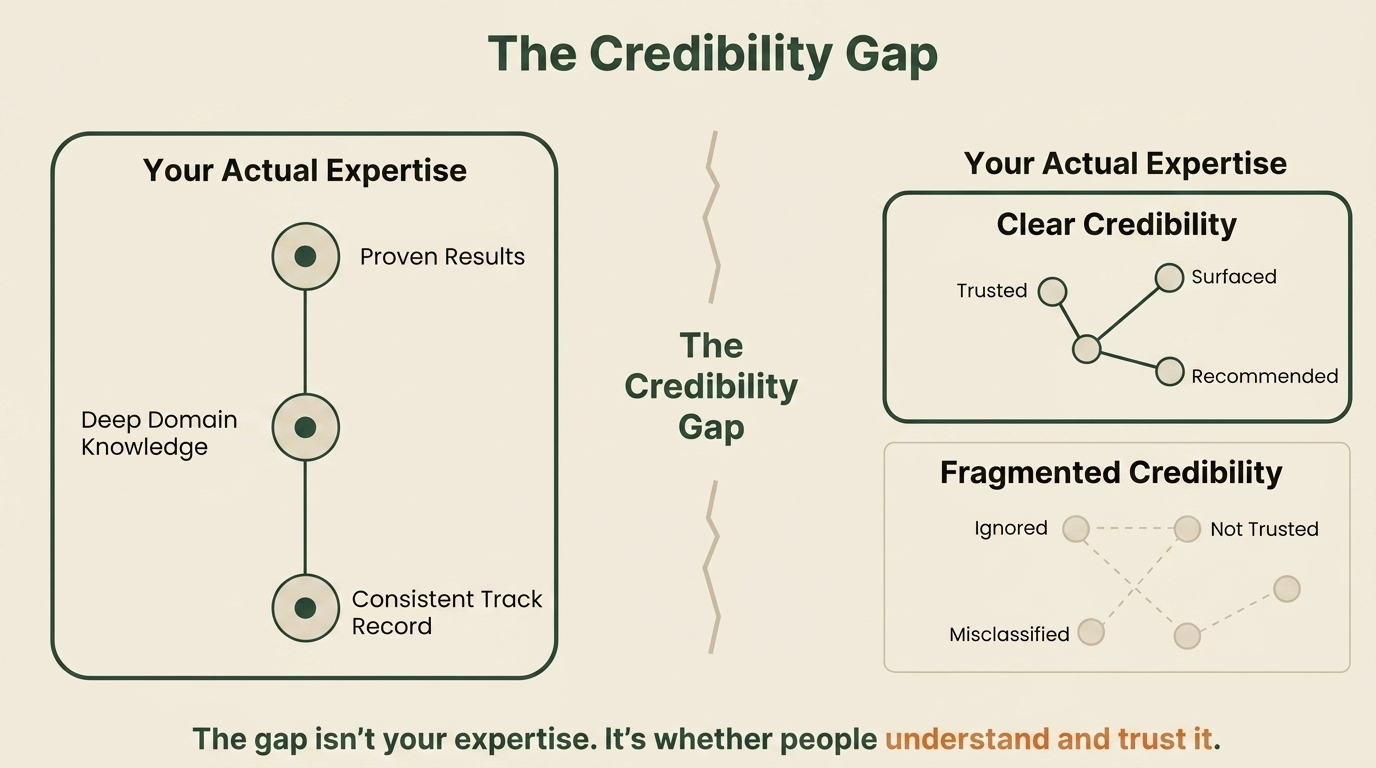
And it’s not because you lack credibility.
It’s because your online identity doesn’t match your real-world reality.
Speaking gigs, board seats, funding, partnerships, media opportunities, clients, and high-value roles do not move toward unclear authority.
They move toward people who are easy to recognize, verify, and trust.
Your authority infrastructure is either increasing trust and opportunity, or silently limiting both.

Most experts are told they need more content, better positioning, stronger personal branding, cold outreach, or lead generation.
So they try it. They post. Pitch. Hire help. Rewrite the bio. Refine the offer. Say yes to every visibility tactic.
But the foundation is still wrong.
Because online authority systems do not judge your expertise the way people who know you do.
They rely on signals.
Signals tell them who you are, what you are credible for, whether your story is consistent, who else validates you, and whether you are trustworthy enough to surface.
When those signals are unclear, scattered, outdated, or competing with stronger signals, the system fills in the gaps with assumptions.
And those assumptions attach the wrong story to you, weaken your authority, or can make you invisible to the opportunities you should be considered for.
Before visibility tactics can work, your authority signals have to be clear, consistent, and verifiable across search, discovery, and distribution systems.
That is what Authority Engineering fixes.

AI looks for patterns.
But you don’t fit the pattern.
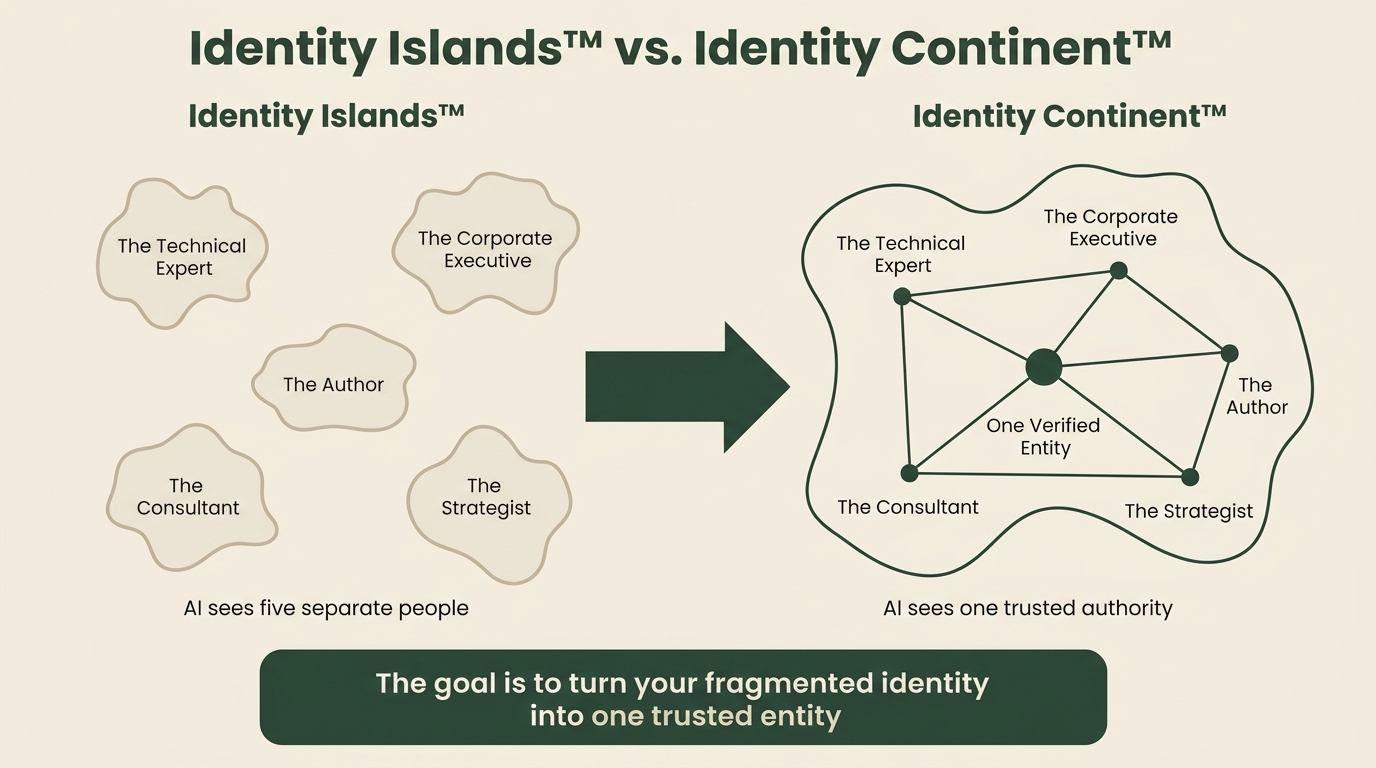
You've built authority across industries, roles, disciplines, companies, or stages of growth. You may be known for judgment, systems thinking, transformation, strategy, technical depth, lived experience, or results that do not fit neatly into one title.
That makes you a black swan expert.
Your value is real, but it is difficult for AI to classify with confidence.
So it starts making assumptions to fill in the gaps.
It pulls old information. Confuses you with someone who shares your name. Ignores your strongest differentiators. Flattens your expertise. Or attaches you to a story that was never yours.
Then it presents that version of you with confidence.
To the people researching you, that wrong story becomes your truth because your authority signals are not strong enough to override the wrong assumptions.
And when opportunities depend on trust and reputation, the wrong story can get you excluded and you would never know why.

I spent nearly two years trying to understand why opportunities stopped finding me.
I had the experience. The track record. The results. I had led at the executive level through a multi-billion-dollar acquisition. And I still couldn’t figure out why the right opportunities weren’t finding me.
I tried everything. Then I Googled myself and understood why.
The story AI was telling about me wasn’t mine. My identity, expertise, and legacy had been fragmented, distorted, and assigned to other people with the same name.
That moment changed everything.
I stopped treating it like a visibility problem. I started treating it like a systems problem.
That led me to reverse engineer how authority signals influence trust, discoverability, verification, and opportunity across AI, search, and digital platforms.
I realized that the underlying systems now used to gate authority are fundamentally flawed when they evaluate human professional experience.
So I built the Authority Engine™: the system behind Authority Engineering that rebuilds the signals machines use to recognize, verify, and trust black swan expertise.
And when the signals changed, the outcomes changed.

I engineer authority infrastructure to make real-world expertise recognizable, verifiable, and trusted online.
AI, search, and discovery systems began sharing the correct story about me.
My 28-year work history attached to me, no longer fragmented across multiple identities
My professional story became more coherent, consistent, and trustworthy, so the right opportunities started finding me.
Previously buried content and credibility signals started resurfacing across search and AI systems.
My identity, achievements, and legacy became easier to verify and trust.
Is your real-world reality reflected online?
Most founders, executives, and experts never realize their authority is being fragmented, flattened, or misclassified.
Even after opportunities stop finding them, they keep solving the wrong problem and wondering why nothing changes.
Tactics won't work until you fix your foundation. You need to know:
How AI is classifying you
Where your authority signals conflict
What signals search, discovery, and distribution systems actually trust
This Authority Diagnostic Prompt reveals:
The wrong story quietly limits opportunities without you ever knowing you were being considered.
Authority Engineering is the deliberate process of structuring, connecting, and corroborating expertise so AI-mediated systems can correctly recognize, verify, trust, surface, and cite it. It is not about gaming algorithms or creating a false image. It is about making real-world credibility understandable to search, discovery, and AI systems.
A Black Swan Expert is a high-achieving professional whose experience, expertise, or career path does not fit predictable patterns. Their credibility is real, but because AI systems struggle to classify them confidently, their authority is often fragmented, flattened, misattributed, or suppressed online.
AI systems rely on pattern matching, statistical confidence, and corroborated authority signals. When a professional has a non-linear career, multidisciplinary expertise, unconventional credentials, or fragmented online signals, AI may struggle to interpret them correctly and start making assumptions to fill in the gaps.
Yes. Search, discovery, and AI-mediated systems increasingly influence who gets surfaced, trusted, recommended, cited, and contacted before a first conversation ever happens. If those systems misunderstand or lack confidence in your authority signals, opportunities can quietly disappear before you even know you were being considered.
Authority flattening is the process where AI systems strip away what makes someone exceptional in order to fit them into a more statistically common and predictable category. This often happens to experts whose careers span industries, disciplines, leadership levels, or unconventional paths.
Referrals still matter, but today even warm referrals are typically followed by online verification. Before someone reaches out, they often search your name, review your profiles, or rely on AI-generated summaries. If your authority signals are unclear or fragmented, the transferred trust from the referral can weaken before contact ever happens.
Authority signals are the digital indicators AI-mediated systems use to interpret credibility, expertise, trustworthiness, and relevance. These include structured data, third-party corroboration, media mentions, professional history, platform consistency, citations, content relationships, and entity associations across the web.
AI systems verify expertise through corroboration and consistency. They compare information across multiple sources to determine whether someone appears credible, trustworthy, and authoritative enough to surface or cite. Strong authority signals increase confidence. Conflicting or fragmented signals reduce it.
Many experienced professionals assume their real-world credibility automatically transfers online. It does not. If AI systems cannot clearly classify, connect, or verify someone’s expertise, they may hesitate to surface them at all. Invisibility is often a trust and interpretation problem, not a competence problem.
No. Personal branding focuses on perception. SEO focuses on search visibility. Authority Engineering focuses on the underlying authority infrastructure AI-mediated systems use to interpret, verify, and trust expertise. SEO and content can support that infrastructure, but they do not replace it.
An Authority Diagnostic is a structured evaluation of how AI-mediated systems currently interpret your authority, expertise, and professional identity. It identifies problems like misclassification, fragmentation, authority flattening, weak corroboration, and trust breakdowns that may be limiting visibility and opportunity.
Yes. This is called entity confusion or identity/entity fragmentation. AI systems can merge, misattribute, or contaminate professional identities when authority signals are weak, inconsistent, or overlap with others who share a similar name, industry, or background.
AI systems are optimized for predictable patterns. Professionals with multidisciplinary expertise, non-traditional backgrounds, rapid advancement, unconventional credentials, or complex career paths often fall outside those expected patterns, making them harder for AI systems to classify confidently.
AI-mediated systems are the search, discovery, recommendation, and distribution platforms that influence visibility, trust, and opportunity through AI interpretation. These include systems like Google Search, AI Overviews, LinkedIn, YouTube, Perplexity, ChatGPT, Bing, and other platforms that mediate access to information and expertise.
Content marketing focuses on publishing information to attract attention. Authority Engineering focuses on building the authority infrastructure that determines whether AI-mediated systems trust, surface, verify, and connect that content to a credible expert identity in the first place.